The "Official" B2B Software Selection Flowchart: Why Your Last Rollout Failed (and How to Fix the Next One)

We’ve all been there. Your boss walks into the room (or the Slack channel) with a "game-changer" idea: "We need a new [insert software name here]!"
The mission seems simple. You have a problem, and somewhere out there, there is a tool to solve it. But then you enter the Software Selection Labyrinth, and things get weird.
The Problem: We’re Choosing Software Like We Choose a Pizza
When you're hungry, a 4.8-star rating and a picture of a pepperoni slice are enough to make a decision. But software isn't a pizza. It’s an engine. If that engine doesn't fit your car’s chassis, it doesn’t matter how many "stars" the manufacturer has—you aren't going anywhere.
Most organizations fall into one of three traps:
- The Shiny Object Trap: You pick the tool with the slickest UI. It looks great in the demo, but three weeks in, your team realizes it’s missing the one "boring" integration they actually need to do their jobs.
- The Hype Train Detonation: You buy the tool because it has "AI-Powered" in the header. You end up paying a 400% premium for what is essentially a series of fancy IF-THEN statements that don't actually automate a single thing.
- The Review Site Echo Chamber: You go to a major review site and see a sea of glowing testimonials. What you don't see is that half of those reviewers were given a $25 gift card to write that "organic" feedback.
Mapping the Chaos: The Flowchart
We built the Official B2B Software Selection Flowchart to show exactly where the process usually goes off the rails.
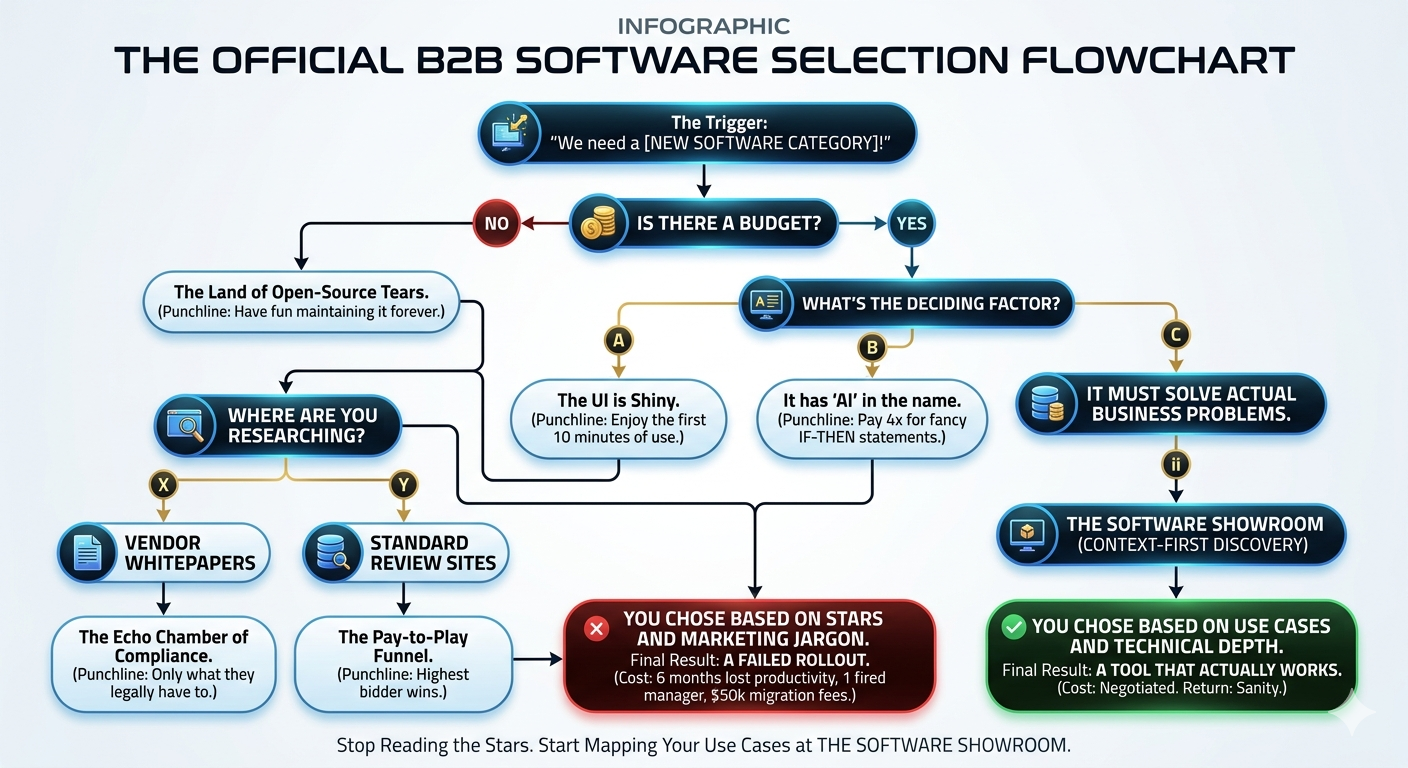
As you can see, most roads lead to a "Failed Rollout." This is the expensive graveyard of software that looked good on paper but died in production. It costs you six months of productivity, a chunk of your budget, and—worst of all—the trust of your team.
The "Success" Path: Context-First Discovery
There is only one way to reach the green box at the end of that flowchart: Stop looking at what people felt and start looking at what the tool does.
Success in software selection requires shifting your focus from "Generic Features" to Specific Use Cases.
- Instead of: "Does it have an API?"
- Ask: "How does it handle two-way data sync with our specific CRM architecture?"
- Instead of: "Is it easy to use?"
- Ask: "Can a junior analyst execute a cross-departmental report in under three clicks?"
Stop Reading the Stars. Start Mapping the Use Case.
At The Software Showroom, we’re tired of the noise. We believe software discovery should be objective, technical, and context-heavy. We don't care about "marketing synergy"; we care about whether the tool solves your problem.
Before you sign that next multi-year contract, ask yourself: Are you following the stars, or are you looking for the truth?
How was this article?
Leave one reaction to help improve future content.